Products / Silica Plastic Block
Waste to wealth
Silica Plastic Block
SPB turns foundry waste and waste plastic into durable construction products. The process uses no cement and no water.
How it works
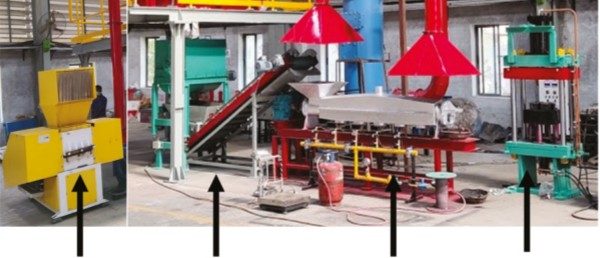
Waste plastic and silica waste are shredded and mixed, melted and extruded at about 250 °C, then moulded under pressure and cooled in water. The mix is 40 to 70% sand and silica waste (foundry dust, burnt sand, construction and demolition waste) and 30 to 60% mixed plastic (LDPE, HDPE, PP, PE, multilayer wrappers, bags and bottles).
- Strength grades M10 to M30
- Zero water absorption
- 100% waste as input
- No cement and no water in the process
What it makes
Products from waste
Paver blocks, interlocking blocks, tiles, planters, furniture, sanitary fittings, road accessories and switch boxes.
Where it stands
From research to supply
Research began in 2017 and the business launched in 2018. The first industry plant was commissioned in January 2021 at AIA Engineering, Ahmedabad: a 100 kg/hr plant, ordered during COVID-19, that turns foundry dust and HDPE bags into paver blocks and bricks (paver blocks tested up to 33.39 N/mm² compressive strength with 0.2% water absorption). The plant at Anand, Gujarat runs as a social enterprise and has supplied West Bengal, the North-East, Maharashtra and Delhi. Paver blocks are laid at a multinational company’s site in Mumbai, and an SPB 250 plant is operating at a customer’s location. Rhino describes SPB as commercially successful.
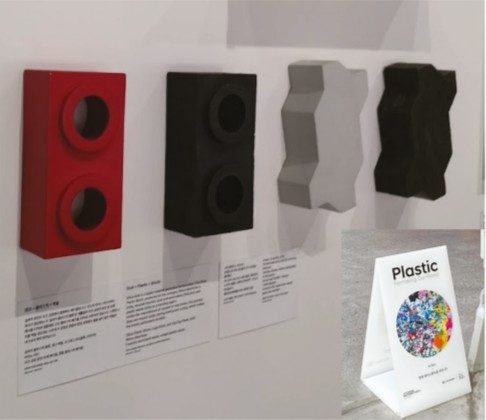
Recognition. The SPB technology is recognised by the Solar Impulse Foundation as an Efficient Solution (approved 3 August 2020; read the assessment report). Rhino donated SPB objects (a Silica Plastic Block, a Lego Brick and Zig-Zag Pavers, 2020) to the collection of the Vitra Design Museum, and they were on display at every venue of its travelling exhibition “Plastic: Remaking Our World”: at Weil am Rhein, Germany (26 March – 4 September 2022), then at V&A Dundee, maat in Lisbon, the National Museum of Singapore (27 January – 23 June 2024) and Hyundai Motorstudio Busan, South Korea (28 August 2024 – August 2025, extended from May 2025). SPB was also recognised as Best Initiative in Plastic Recycling and Waste Management as an SME/MSME at the Indian Sanitation Coalition (FICCI) in 2024.


SPB products are sold through Meemansa SPB.
Installations
SPB plants supplied
Plants supplied each year
A further 250 kg/hr scale-up order from an industry customer is in progress.
Who has taken an SPB plant
| Segment | Plants | Capacity (kg/hr) |
|---|---|---|
| Industry and CSR | 3 | 10 to 250 |
| Start-ups and incubation | 3 | 10 to 100 |
| Research institutions | 2 | 5 to 10 |
| Social and community | 2 | 5 |
| Shared production and research (Meemansa) | 3 | 10 to 250 |
| Urban local body, Nepal | 1 | 100 |
| Global partnership, Australia | 1 | 10 |
The reference list names the plants. One further plant is not shown. Counts as of December 2025.
Sustainable Development Goals
SDG impact score
Each goal is scored from −3 to +3 for how far SPB moves it. SPB scores the maximum, +3, on 11 goals, including responsible consumption, climate action, life below water, life on land, sustainable cities and decent work. It scores 0 on zero hunger, affordable and clean energy, and peace, justice and strong institutions.
SPB gives rag-pickers and weaker sections a way to earn from waste, includes women in decentralised production, and keeps plastic and industry dust out of landfill and burning.
Scores are Rhino’s own assessment, not an independent audit.
Request the SDG impact noteGallery
Silica Plastic Block photo gallery


Select a photo to enlarge it.
Rajnikant Paghadar, SPB and Sand Reclamation Technologies
+91 95379 71060